
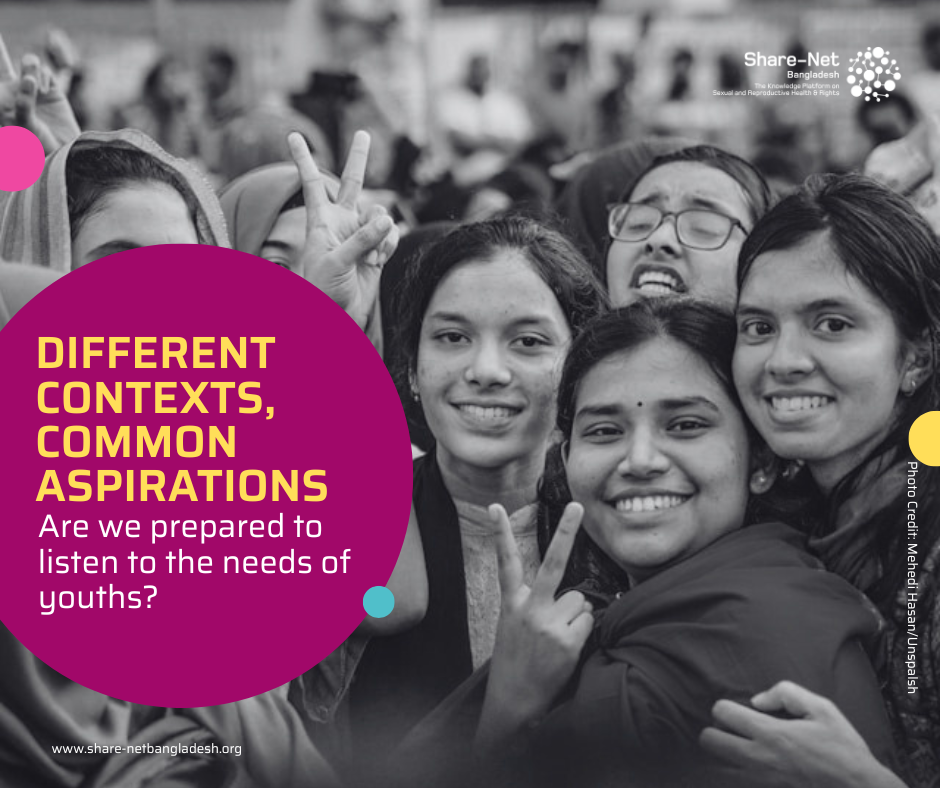
Different Contexts, Common Aspirations: Are we prepared to listen to the needs of youths?
A young person in a remote village, a student in Dhaka, and a teenager living in a climate-vulnerable community may have very different lives. Yet they may want remarkably similar things: the freedom to make decisions about their future, access to education and health services, decent opportunities, and the right to live with dignity.
That is the idea behind International Youth Day 2026, observed on 12 August under the theme “Different Contexts, Common Aspirations.” The United Nations is using the theme to highlight how young people face different social and economic realities while sharing common aspirations for dignity, opportunity, health, inclusion and a sustainable future.
For Bangladesh, the theme has particular relevance to sexual and reproductive health and rights (SRHR). A young person’s ability to realise those common aspirations can depend heavily on where they live, their gender, family income, education and social background.
Bangladesh has made progress in reducing child marriage, but the pace remains too slow. UNICEF’s latest Bangladesh data shows that 47.2 percent of women aged 20 to 24 were married before 18, while 13.4 percent were married before 15. UNFPA has warned that, at the current rate of progress, ending child marriage could still take more than two centuries.
The consequences extend far beyond marriage itself. Child marriage can restrict education, reduce decision-making power and increase exposure to early pregnancy and violence. UNFPA reports that Bangladesh has one of the highest adolescent pregnancy burdens in the region, while the WHO stresses that preventing adolescent pregnancy requires action on education, child marriage, gender norms and access to SRH information and services.
This is where the 2026 theme becomes more than a slogan. “Different contexts” means recognising that a rural adolescent, a married teenager, a young person with a disability or someone from a marginalised community may face very different barriers. “Common aspirations” means ensuring that those differences do not determine who gets to enjoy health, safety, education and opportunity.
There are encouraging signs. In 2024, UNFPA-supported programmes engaged more than 300,000 women in community dialogues, trained 279 grassroots organisations on child marriage prevention, and provided life-skills education to more than 44,700 adolescents. Twenty-five youth-led organisations across 10 districts were also supported to advocate for adolescent health and wellbeing.
Yet awareness alone will not be enough. The real test is whether young people can influence decisions, access confidential and accurate SRHR information, stay in education, and find services that respond to their needs.
International Youth Day therefore offers Bangladesh an opportunity to ask a difficult but necessary question: Are young people being invited merely to speak, or are institutions prepared to listen and act?
The answer will determine whether “common aspirations” remain a UN theme for one day, or become a practical commitment to giving every young person a fairer chance to shape their own future.
